Risk management Security audit How it works Coverage Pricing Get started
Security risk management · Security audit

Rank every risk.
Audit every change.

Two products on the same codebase. Risk management keeps one register for every service you run, scored on where each flaw lives. Security audit reviews every change with a pipeline of agents, then verifies each finding before it reaches you. What the audit finds, the register keeps.

Get started → See how they fit together
01 · Security risk management

A thousand findings. One ranked register.

Every finding consolidated into one register and scored on what the flaw is, where it runs, and which service it sits in.

  • Services ranked worst first, weighted by how critical each one is
  • Risks keep their identity and their triage across scans
  • Semgrep findings ranked beside our own analysis
Explore risk management →
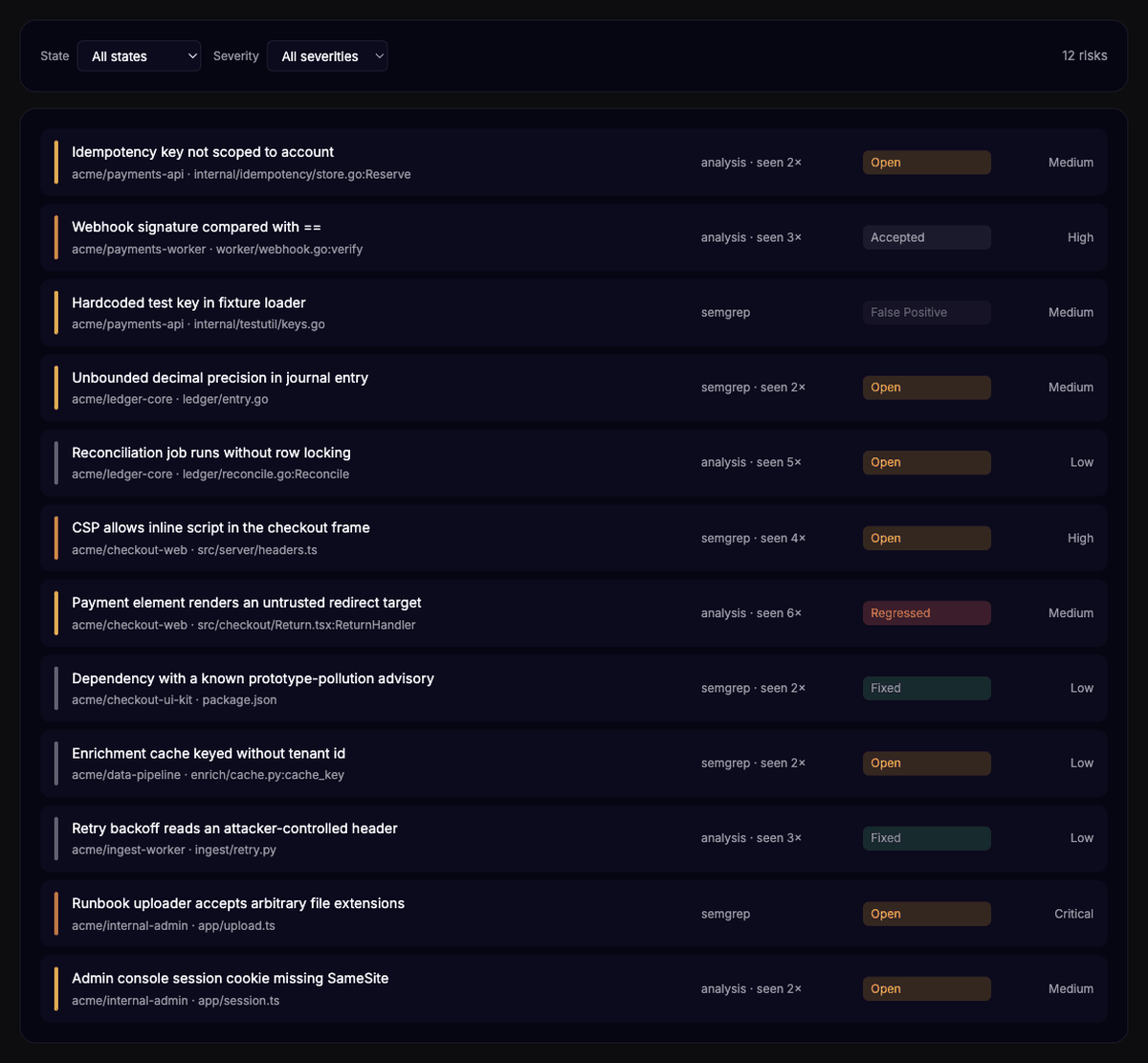
The SafeStackAI risk register listing risks across repositories, each with its file path, whether it came from analysis or semgrep, how many times it has been seen, a state badge and its severity.
02 · Security audit

An audit on every change, verified before you see it.

A pipeline of agents maps the code and proposes findings, then puts each one through a verification stage that confirms it or drops it.

  • Duplicates folded into one finding, so one bad pattern reads as one problem
  • Pull request review on the diff, a full audit on every merge
  • A PDF report you can hand over, critical findings first
Explore security audit →
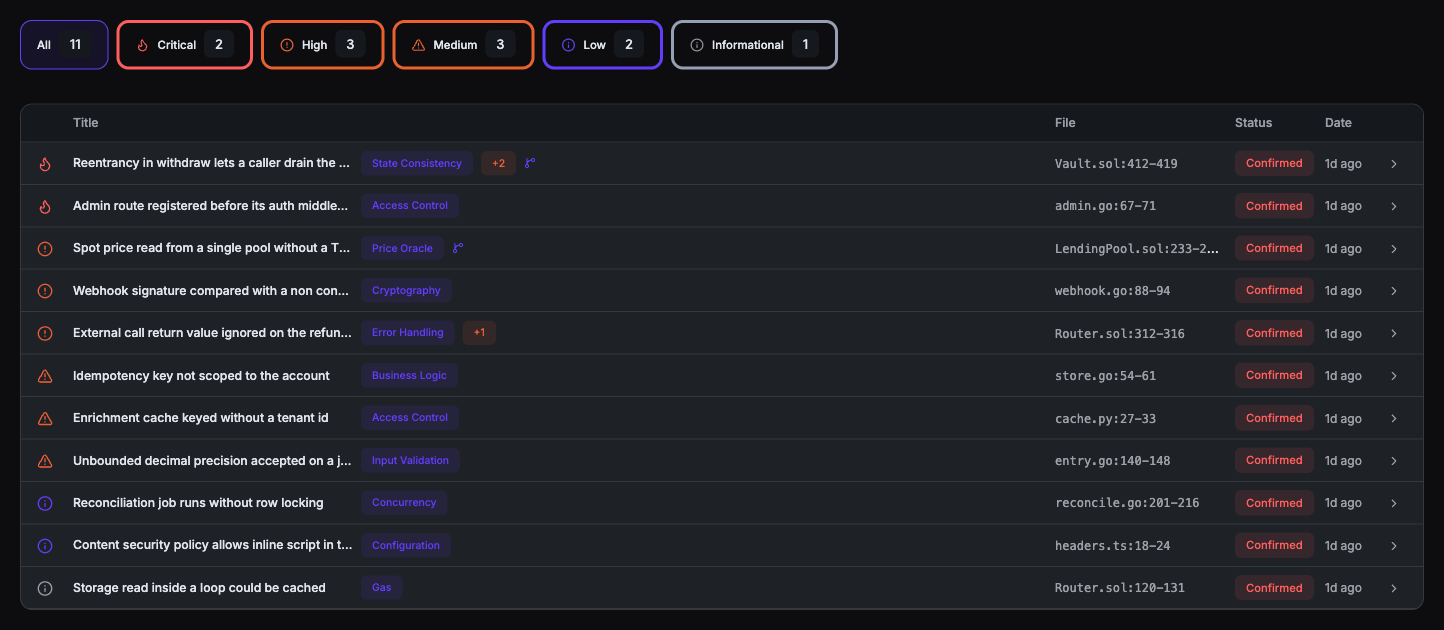
The analysis result for a repository: severity chips reading 11 findings in total, 2 critical, 3 high, 3 medium, 2 low and 1 informational, above a table of findings such as reentrancy in withdraw and an admin route registered before its auth middleware, each with a category tag like State Consistency or Access Control.
How they fit

A finding is an input.
A risk is something you own.

Most scanners give you a list and stop there. The list grows, the same issue comes back under a new line number on every run, and severity gets assigned as if every repository mattered the same.

SafeStackAI splits the job in two. The audit decides what is real. The register decides what matters, and remembers the decision.

Security audit hands over

A verified finding

  • Confirmed in verification, or dropped before you see it
  • Severity, category and the exact lines
  • What is wrong and a recommended fix
  • Duplicates already folded into one
Risk management keeps

An owned risk

  • An identity that holds when the code around it shifts
  • A triage decision that sticks across every scan
  • A score weighted by the service it sits in
  • A regression flagged when a fixed risk comes back
Product 01Security risk management

Know where you stand, service by service.

Every finding lands in one risk register, scored on what the flaw is, where it runs, and which service it sits in. The same flaw counts for more in a production payments service than in an internal tool.

0
Weight on a settled risk
5
Factors in every risk score
1.2×
Weight on a regression
2
Sources, our analysis and Semgrep
The model

Severity alone is not a priority.

A critical finding in something nobody can reach is not your biggest problem. Every risk is scored on five factors, and two of them come from the service it belongs to. Group your repositories into services, set how critical each one is, and the ranking follows.

risk = severity × exploitability × criticality × exposure × state      service rank = Σrisk, worst first

Severity

As the analysis reports it.

critical10
high7
medium4
low1

Exploitability

A 0–10 assessment, floored at 0.3. Hard to exploit is still a finding.

assessed0.3–1.0
unassessed0.65

Criticality

How much the service matters. You set this.

critical2.0
important1.5
standard1.0
low0.6

Exposure

Code not reachable from production is a smaller problem.

production1.0
staging0.6
internal0.5
development0.3

State

A decision you already made is not an outstanding risk.

regressed1.2
open1.0
settled0

Services carry the context

A repository on its own tells you nothing about blast radius. Group repositories into services, set criticality and environment once, and every risk underneath gets scored against real business context.

  • A service spans as many repositories as it needs
  • Services ranked worst first, so the one that needs attention is at the top
  • Repositories with no service stay visible, because that gap is worth knowing about
  • Change a service's criticality and its whole register re-ranks
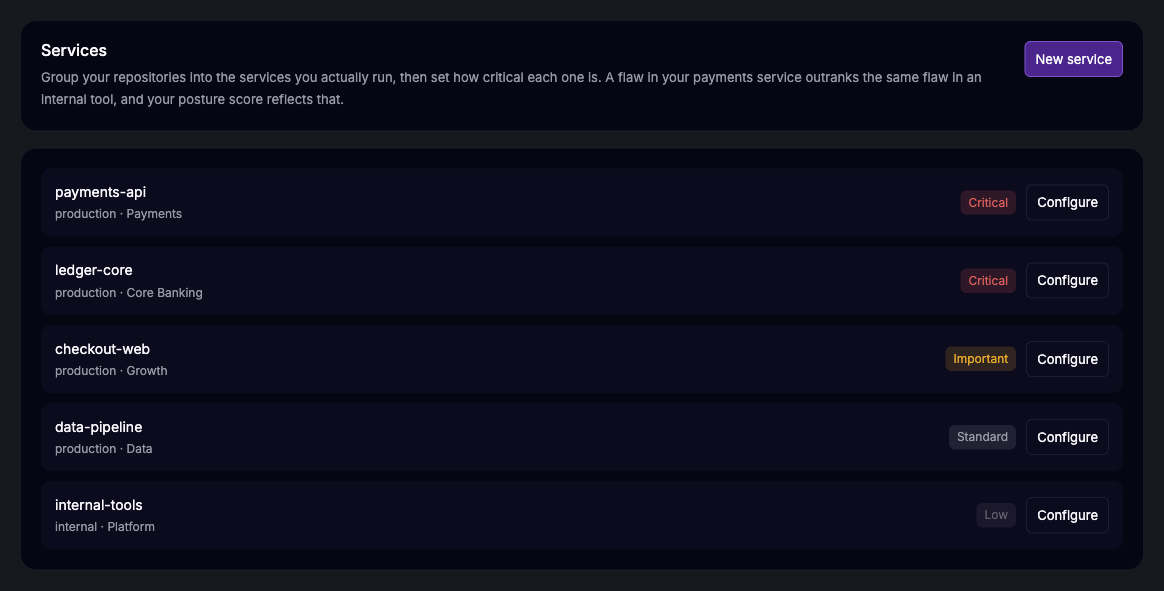
The Services page listing payments-api, ledger-core, checkout-web, data-pipeline and internal-tools, each showing its environment and owning team alongside a criticality badge and a Configure button.
Services. Criticality and environment, set once per service.
The register

The same risk, run after run

Findings are fingerprinted, so a risk keeps its identity when the line numbers around it shift. Dismiss something once and it stays dismissed. If a fixed risk comes back, the register marks it regressed instead of filing it as new.

  • Every risk carries a state: open, false positive, fixed or regressed
  • Settled risks contribute nothing to the score. A regression counts for more than a fresh finding, because a fix that escaped is also a process failure
  • Every risk shows its source, analysis or Semgrep, and how many times it has been seen
  • Filter by state and severity across every service at once
The risk register listing twelve risks across repositories. Each row shows the title, repository and file path, whether it came from analysis or semgrep, how many times it has been seen, a state badge reading Open, Accepted, False Positive, Regressed or Fixed, and its severity.
Risk register. Origin, observation count and state on every row.
Sources

Bring what you already run.

Findings from more than one engine land in the same register, under the same severity model, ranked against each other.

SafeStackAI security audit

Hundreds of vulnerability checks across six languages, run with full repository context and verified before they reach the register.

Semgrep

Connect your existing projects and their findings become risks in the same register, scored against the service they belong to.

Pull request review

Reviews run on the diff and post back to the pull request, and each review shows which existing issues the change resolved.

Custom security rules Coming soon

Rules your team writes, applied to every risk in the register, whichever engine found it.

Product 02Security audit

It audits, then checks its own work.

A manual audit is thorough and it happens once. The next pull request lands against a report that is already out of date. This runs the same kind of review on every change, and it is a pipeline of agents rather than one pass with a pattern list.

6
Languages on one agent pipeline
5
Stages between code and report
2
Audit passes run in parallel
PDF
A report you can hand over
The pipeline

Five stages between the code and the report.

Each stage does one job, and nothing reaches the report without passing verification.

01

Context

The code is mapped first: call flow, entry points, and a threat model of what an attacker would go after.

02

Discovery

Two audit passes read the code in parallel while static analysis runs against it at the same time.

03

Deduplication

The same defect reached through several paths is folded into one finding before anything is judged.

04

Verification

Every remaining finding is confirmed or dropped. Anything the verifier cannot settle is kept for your review.

05

Write-up

What survives is written out the way an audit report is, with severity, the exact lines and a recommended fix.

Pull request review runs its own pipeline, planning checks for each changed file and handing them to specialist agents.

The findings

Findings that argue their case.

Every result comes back with the reasoning behind it. Severity, the category it falls under, the exact lines, what is wrong and how to fix it.

Context, not just severity

Agents map call flow, entry points and a threat model before they look for flaws, so each finding is judged against how the code is actually reached.

Verified before you see it

Every proposed finding goes through a verification stage that confirms it or drops it. Anything it cannot settle is kept for your review rather than silently discarded.

Duplicates collapse

The same defect reached through several paths folds into one finding with a count, so a repository with one bad pattern does not read as twenty separate problems.

A report you can hand over

Each run is written up the way an audit report is, not dumped as a list. The PDF carries the commit, how many files were analysed, and the findings critical first.

Dismissals need a reason

Dismissing a finding takes a reason and a written justification, so the next person to read it knows why it was closed.

No sign off with work pending

An audit cannot be marked reviewed while any of its findings is still waiting on a decision.

AI console

Ask the codebase, not the ticket.

Open a session on any analysis and question the findings against the code that produced them. The assistant reads the repository at the analysed commit and points to the file and line behind each answer, so you can check it instead of trusting it.

An answer you can verify

A session streams its answer as it works through the code. When there is a fix, it comes as a diff you can copy straight into the branch.

  • Runs against the repository at the exact commit that was analysed
  • Answers point to the file and line
  • Proposed fixes arrive as a diff, one click to copy
  • Pick an investigation back up with its transcript carried over
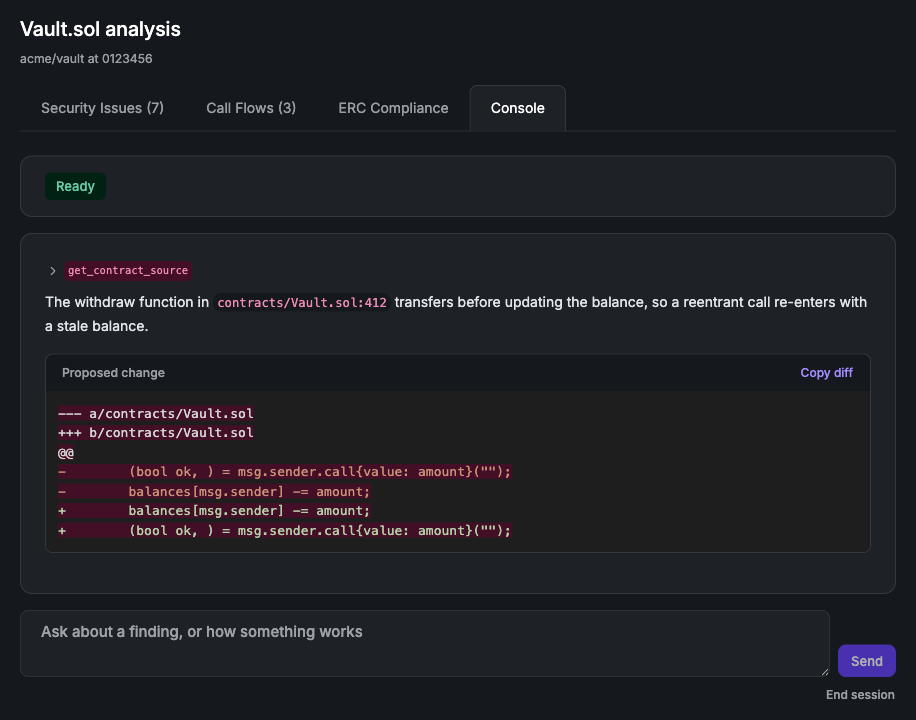
The AI console tab on an analysis of Vault.sol, showing a Ready badge, an expandable get_contract_source tool call, an answer explaining that the withdraw function transfers before updating the balance so a reentrant call re-enters with a stale balance, and a proposed diff reordering the two statements with a Copy diff action.
AI Console. A live session on an analysis, with the proposed patch.
Smart contracts

Read the contract, not the lint.

Smart contract audits follow execution instead of matching patterns.

Call flow

Every entry point traced as an execution tree and as a call graph.

Slither alongside

High-value Slither detectors run next to the agents on every Solidity audit.

Attack vectors

Ranked by severity, each carrying a confidence score.

ERC and EIP compliance

Scored contract by contract against the standards it implements.

How it works

Connect GitHub. No CI to maintain.

Install the app, connect your repositories and switch on automatic review. There is no workflow file to add, no CI step to maintain, no scan to schedule and nobody to remember to run one. Both products run from that one install.

01 · Once

Install and pick repos

Install the GitHub App, connect the repositories you want watched and turn on automatic review. Nothing goes into your CI.

02 · Every pull request

Reviewed as it opens

Opened, reopened, or pushed to again, the diff gets reviewed with the repository's context behind it and the findings post back to the pull request.

Security audit
03 · Every merge

Full audit on the default branch

A merge to the default branch starts a complete audit of the repository, and every finding is fingerprinted against what the register already holds.

Security auditRisk management
04 · Continuously

The register keeps itself

New risks are added, returning ones matched to their history, scores move with them. The register reflects the last commit rather than the last audit.

Risk management
Coverage

Six languages. One audit pipeline.

Smart contracts and the services around them, reviewed by the same agents and held to the same verification.

SoliditySMART CONTRACTS
GoSERVICES · APIs
PythonSERVICES · DATA
RustSYSTEMS · CHAIN
JavaScript / TypeScriptWEB · APIs
MoveSMART CONTRACTS
Pricing

Pay for what the analysis uses.

Save 17%
Starter
$150/mo
A single project
under continuous review

Everything you need to audit one codebase on every change.

  • Full-repository audits across six languages
  • Pull request review on the diff, posted back to the pull request
  • Semgrep findings in the same register, scored the same way
  • AI console sessions on any analysis, at the commit it ran against
Subscribe
Enterprise
Custom
Unlimited repositories
customized for enterprise

Custom plans tailored to your needs.

  • Token packages and on demand usage
  • Every team and service in one register
  • Custom limits on repositories and services
Contact us
Token rate $4.80 per 1M input $24.00 per 1M output Input and output are metered separately.
Top-ups $5.00 per 1M input $25.00 per 1M output Top-up tokens do not expire.